
A practical guide for business owners, property managers and anyone responsible for painting a commercial space
Walk into a commercial bathroom with peeling paint, watermarks streaking down the walls, and a ceiling that looks like it’s been damp since the Howard era. You notice it immediately. So does everyone else who uses it.
Paint is often the last thing on a business owner’s mind when they think about a bathroom refresh, but it does a lot of heavy lifting. It protects the substrate, covers water damage, and sets the overall tone of the space. Done right, a fresh paint job in a commercial bathroom can hold up for years. Done wrong, it starts failing within months and you’re back to square one.
Here’s what to think about before you hire anyone to put a brush near your bathroom walls.
Bathrooms are the hardest rooms to paint well
This isn’t a bathroom-specific problem so much as a surfaces and conditions problem. Commercial bathrooms deal with constant moisture, temperature swings from hot showers or hand basins, cleaning chemicals used multiple times a day, and physical wear from people and equipment in a confined space.
Standard interior paint does not cope with any of that. It traps moisture rather than managing it, which leads to bubbling, peeling, and mould growth behind the paint film. If that’s happened in your bathroom before, it’s almost certainly a product or preparation issue, not just bad luck.
A commercial painter who knows what they’re doing will treat a bathroom completely differently to an office, hallway, or retail floor. The product selection, surface preparation, and application method all change. If someone quotes you a bathroom job and doesn’t mention any of that, ask questions.
Surface preparation is most of the job
This is where inexperienced operators cut corners and where professional painters earn their keep. In a commercial bathroom that’s been painted before, the existing surface has almost certainly had some moisture exposure. Even if it looks fine, there may be areas of adhesion failure, old silicone residue, soap scum build-up, or minor mould growth that needs treating before anything new goes on.
Painting over a compromised surface is a waste of everyone’s time and money. The new paint will fail in the same places the old paint failed, often faster because it’s sitting on top of a deteriorating base.
Proper preparation for a commercial bathroom typically includes:
- Washing down all surfaces to remove contaminants, grease, and soap residue
- Sanding back any areas of peeling or flaking paint
- Treating any mould or mildew with an appropriate biocidal wash before painting begins
- Applying a quality primer, particularly on bare or patchy surfaces
- Filling and feathering any cracks, holes, or surface damage
None of this is glamorous. It adds time to the job. But it’s the difference between a finish that holds up for five years and one that starts failing by winter.
Product selection matters more than colour
Once the surface is ready, the paint you put on it does the real work. For a commercial bathroom, you want a product specifically formulated for wet and humid environments. These are typically semi-gloss or gloss finishes with moisture-resistant properties and a harder film that withstands repeated cleaning without degrading.
In Queensland’s climate, mould resistance is non-negotiable. Brisbane’s humidity is not gentle on surfaces, and a bathroom that doesn’t get adequate ventilation between uses is a mould factory. A good moisture-resistant paint with a fungicide additive slows that process significantly.
Sheen level matters practically, not just aesthetically. Higher sheen finishes (semi-gloss, gloss) are easier to clean and more resistant to moisture absorption than flat or low-sheen paints. Some business owners opt for flat paint because it hides surface imperfections, but in a bathroom that decision will cost you in maintenance down the track. Embrace the sheen.
For ceilings specifically, look for a product marketed as a bathroom ceiling paint. These are formulated to handle the steam and condensation that rises and sits on ceiling surfaces, which behave differently to walls in terms of moisture exposure.
Colour choices for commercial bathrooms
This might seem like a minor point compared to preparation and product selection, but colour has a functional dimension in commercial bathrooms that’s worth thinking about.
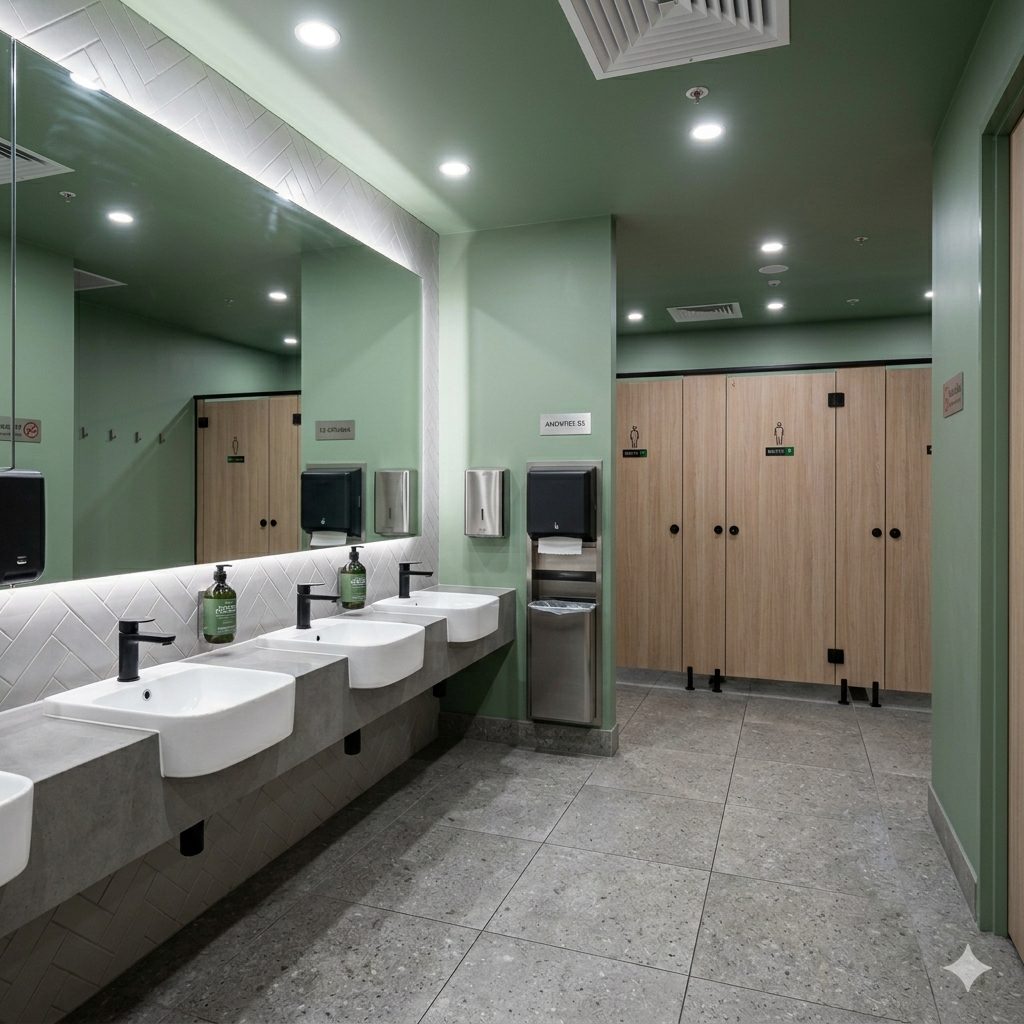
Very light colours show marks and scuffs quickly in high-traffic environments. Very dark colours can make a small commercial bathroom feel oppressive and make watermarks more visible, not less. Mid-tones in the warm or cool neutral range tend to hold up visually between cleans and feel more spacious without being clinical.
If you’re working within a brand colour palette, bathrooms are generally not the right place to go bold. Accent walls and strong colours work better in spaces where people linger. In a bathroom, the goal is clean, functional, and well-maintained. Neutrals deliver that more reliably.
Whatever you choose, get the colour applied as a sample on the actual wall surface before committing to the full job. Bathroom lighting, often downlights or strip lighting without natural light, changes colour perception significantly compared to how a colour chip looks in a brochure or on a screen.
Ceilings, trim, and the bits people miss
A common mistake is repainting walls and ignoring everything else. Ceilings in commercial bathrooms take a beating. Condensation accumulates, mould appears in corners, and the surface gets stained over time. If you’re repainting the walls and leaving a yellowed or patchy ceiling, the overall result is going to look unfinished.
Trim work, door frames, skirting boards, and architraves also need attention. These get scuffed by cleaning equipment, knocked by trolleys, and accumulate grime in the recesses. A semi-gloss or gloss finish on trim makes cleaning easier and gives the whole space a crisper result.
If your bathroom has exposed pipework, that’s also worth considering. Painting pipes to match the wall colour makes the space feel more intentional and easier to clean around. A good commercial painter will factor all of this into the scope rather than just rolling the main wall surfaces and calling it done.
Timing the job to minimise disruption
Commercial bathrooms can’t be out of service indefinitely. For most businesses, even a day or two without amenities is a significant inconvenience for staff and customers.
The good news is that a properly scoped bathroom painting job doesn’t need to run for a week. A professional team with the right preparation work done upfront can typically complete a standard commercial bathroom in one to two days depending on size and condition. The drying time between coats is often the limiting factor, which is where proper ventilation and appropriate products help.
If you have multiple bathrooms or cubicles, staggering the work so at least one facility remains available is straightforward to plan. Discuss it with your painter before the job starts rather than raising it halfway through.
For businesses where any disruption is difficult, early starts or weekend work is worth discussing. A commercial painter experienced with business premises will have done plenty of after-hours jobs and can plan accordingly.
What good looks like when the job is done
A properly painted commercial bathroom should look even and consistent across all surfaces with no roller marks, lap lines, or visible brush strokes in the finished coats. Edges should be crisp where paint meets tiles, fixtures, or trim. There should be no paint on tap fittings, tiles, or floor surfaces.
The finish should be wipeable immediately once cured, which for most quality paints is 24 to 48 hours after the final coat depending on conditions. Your painter should be able to tell you the cure time for the specific product used.
If there was mould treatment done prior to painting, there should be no visible return of mould growth for a significant period, provided ventilation in the space is adequate. If mould keeps returning within months of a fresh paint job, the issue is likely ventilation rather than the paint, and that’s a separate problem worth addressing.
Why it’s worth using a commercial painter rather than a general handyman
The gap between a general handyman painting a commercial bathroom and a commercial painter doing the same job is not subtle. It shows up in surface preparation, product selection, application technique, and finish quality. It also shows up in how long the job lasts.
Commercial painters working in Brisbane’s business environment understand the conditions, the products that perform, and the practical constraints of working in an operating business. They carry the appropriate licences, use trade-grade materials, and stand behind the work with a warranty.
For Trade Painters, all work is completed by Dulux Accredited painters using Dulux products, which comes with a five-year warranty on application. That kind of backing means if something isn’t right, there’s a process to fix it, not a shrug and a disconnected phone number.
A freshly painted commercial bathroom is a low-cost way to significantly lift the impression your business makes. It’s not a renovation. It doesn’t require major downtime or a large budget. But it does require the right approach from the people doing it.